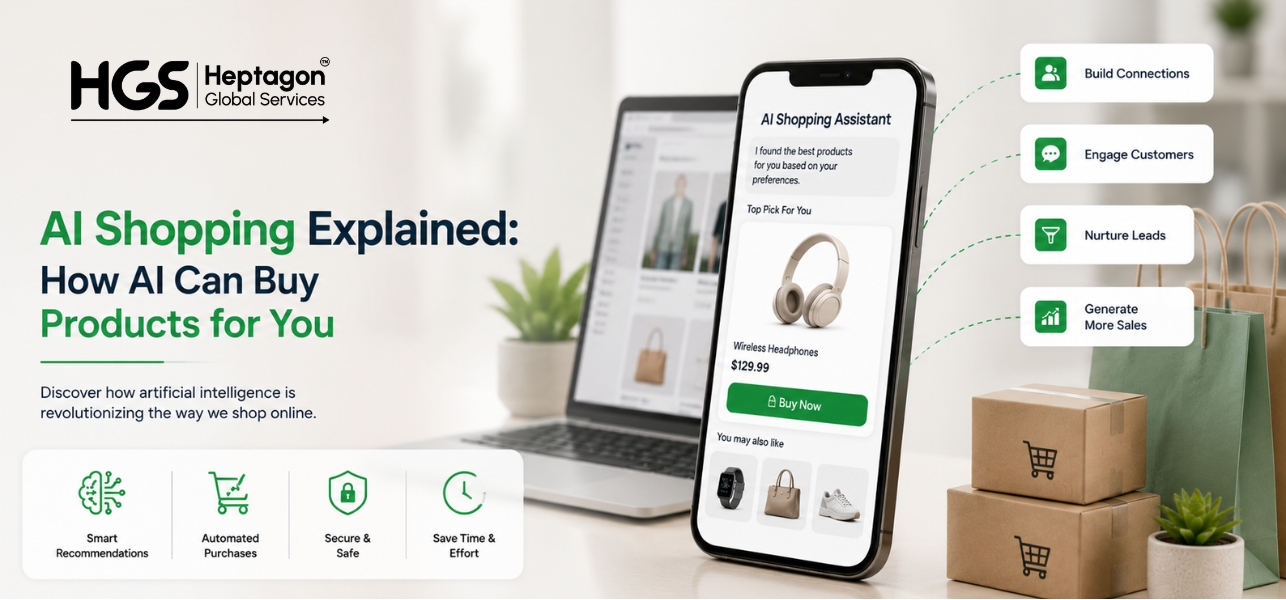
Shopping has changed dramatically over the past two decades. We moved from visiting physical stores to browsing online marketplaces, comparing prices on multiple websites, and reading countless reviews before making a purchase. While online shopping made buying products more convenient, it also introduced a new challenge—too many choices.
Today, a simple search for "wireless headphones" or "gaming laptop" can return thousands of results across dozens of websites. Consumers often spend hours comparing prices, specifications, delivery dates, customer reviews, and return policies before deciding what to buy.
But what if you no longer had to do any of that?
Imagine simply telling an AI:
"Find me the best laptop under $1,500 for video editing, compare prices across trusted websites, apply available discounts, and place the order with the fastest delivery."
Within seconds, the AI researches products, compares retailers, checks reviews, applies coupons, selects the best option, and—if you've authorized it—even completes the purchase for you.
This is no longer science fiction.
Welcome to the world of AI Shopping, one of the biggest transformations in e-commerce since online shopping itself.
Instead of acting as a search engine, modern AI is evolving into a shopping agent—an intelligent assistant capable of understanding your preferences, making recommendations, comparing products, and carrying out purchasing tasks on your behalf.
Industry experts often refer to this new era as Agentic Commerce, where AI doesn't just answer questions but actively performs tasks for users. Major technology companies including OpenAI, Google, Amazon, Microsoft, Visa, Mastercard, and several leading e-commerce platforms are investing heavily in AI-powered shopping experiences.
For consumers, this means faster, smarter, and more personalized shopping.
For businesses, however, it represents one of the biggest shifts in digital marketing and e-commerce strategy in years.
Traditional SEO focused on getting people to click your website.
AI Shopping changes the equation.
Now your products must be discoverable, understandable, and trustworthy—not just for humans, but also for AI agents making purchasing decisions.
Businesses that prepare early could gain a significant competitive advantage, while those that ignore this transformation risk becoming invisible in AI-driven shopping experiences.
In this guide, we'll explain how AI Shopping works, why it's becoming the future of e-commerce, how AI agents purchase products, and what every online business should do to prepare for this new era of digital commerce.
What Is AI Shopping?
AI Shopping refers to the use of artificial intelligence to assist—or even automate—the entire shopping journey.
Instead of manually searching websites, comparing products, and checking out yourself, an AI shopping assistant can perform these tasks on your behalf.
Think of it as a highly intelligent personal shopper that understands:
- Your budget
- Your preferences
- Your previous purchases
- Your favourite brands
- Product reviews
- Delivery timelines
- Available discounts
- Return policies
Rather than simply providing links, AI analyzes information from multiple sources to recommend the product that best matches your needs.
For example, instead of typing:
"Best smartphone under $900"
You could simply ask:
"Buy me the best Android phone under $900 with an excellent camera and two-day battery life."
The AI may then:
- Search multiple retailers.
- Compare prices.
- Read thousands of reviews.
- Check product ratings.
- Verify seller reliability.
- Apply coupons or promotional discounts.
- Select the best option.
- Add it to your cart.
- Complete the purchase after your approval—or automatically, if you've enabled that feature.
This shift from searching to delegating is what makes AI Shopping revolutionary.
How Does AI Shopping Work?
Although AI Shopping appears simple from the user's perspective, several advanced technologies work together behind the scenes.
Step 1: Understanding Natural LanguageModern AI systems understand conversational language rather than relying only on keywords.
Instead of searching for:
"Running shoes size 10"
You can say:
"I need lightweight running shoes for marathon training, size 10, under $150, with fast delivery."
The AI understands:
- Product type
- Budget
- Size
- Intended use
- Delivery preference
- Quality expectations
Unlike traditional search engines that primarily display webpages, AI shopping agents search across multiple retailers simultaneously.
They may compare products from:
- Brand websites
- Online marketplaces
- Local retailers
- E-commerce platforms
- Specialty stores
The AI gathers pricing, availability, delivery estimates, customer ratings, and specifications before narrowing down the best choices.
Step 3: Comparing ProductsThis is where AI truly saves time.
Instead of opening ten browser tabs yourself, AI compares:
- Price
- Features
- Reviews
- Battery life
- Warranty
- Shipping cost
- Seller reputation
- Return policy
It then recommends the option that best matches your priorities—not just the cheapest one.
Step 4: Completing the PurchaseWith user permission, AI shopping agents can move beyond recommendations and actually complete purchases.
Depending on the platform, the AI may:
- Add items to your cart.
- Apply coupons automatically.
- Select the fastest shipping option.
- Fill in your delivery details.
- Use secure payment credentials.
- Confirm the order.
This transforms AI from a chatbot into a true digital shopping assistant.
Why AI Shopping Is Different from Traditional Online Shopping
Traditional e-commerce requires users to perform every step manually.
AI Shopping removes much of that effort by acting on behalf of the customer.
| Traditional Shopping | AI Shopping |
|---|---|
| Search manually | Describe what you need |
| Visit multiple websites | AI searches across retailers |
| Compare reviews yourself | AI summarizes reviews |
| Look for discounts | AI finds available offers |
| Choose the product | AI recommends the best match |
| Complete checkout manually | AI can handle checkout with approval |
This saves time, reduces decision fatigue, and makes shopping more personalized.
Why AI Shopping Is Growing So Quickly
Several technological advances are driving the rapid adoption of AI Shopping:
- More powerful AI models capable of understanding complex requests.
- Better product data and structured information from retailers.
- Secure payment technologies that allow AI to transact safely.
- Growing consumer trust in AI assistants.
- Increasing demand for faster and more convenient online shopping.
As these technologies mature, AI Shopping is expected to become a standard part of how people buy products online rather than a niche feature.
As artificial intelligence becomes more capable, the way people shop online is evolving rapidly. AI is no longer limited to answering questions or generating content—it is now becoming an active participant in the buying process. This new era, often called Agentic Commerce, allows AI to research products, compare options, and even complete purchases on behalf of users.
For businesses, this represents one of the biggest changes since the rise of Google Search. Companies that adapt their websites, product information, and digital marketing strategies today will be in a much stronger position as AI-powered shopping becomes mainstream.
What Is Agentic Commerce?
Agentic Commerce is the next evolution of e-commerce.
Instead of simply helping customers find products, AI agents actively perform shopping tasks.
Think of an AI agent as your personal shopping assistant. You don't have to browse dozens of websites or compare hundreds of products. You simply explain what you need, and the AI handles the rest.
For example:
"Find me the best ergonomic office chair under $300 with lumbar support, at least a 4.5-star rating, and delivery within three days."
An AI shopping agent can:
- Search multiple online stores.
- Compare specifications.
- Read thousands of customer reviews.
- Check return policies.
- Find discount coupons.
- Compare delivery times.
- Recommend the best option.
- Complete the purchase after receiving approval.
This dramatically reduces the time consumers spend researching products while helping them make better-informed decisions.
How Major Companies Are Building AI Shopping
Nearly every major technology company is investing heavily in AI-powered commerce.
OpenAIChatGPT is gradually evolving beyond a conversational assistant into a shopping companion. Users can already receive personalized product recommendations, compare options, and discover products through natural conversations. As AI capabilities expand, shopping experiences are expected to become even more seamless.
GoogleGoogle is integrating AI into Search and Shopping through Gemini and AI-powered search experiences. Instead of displaying only product listings, Google increasingly summarizes comparisons, highlights key features, and helps users make faster purchasing decisions.
AmazonAmazon has introduced AI features that help shoppers discover products more efficiently. These tools summarize reviews, answer product questions, and provide personalized recommendations based on user preferences and shopping history.
Visa & MastercardPayment companies are preparing for the next stage of AI commerce by developing secure systems that allow AI agents to complete purchases on behalf of customers while maintaining strong authentication and fraud protection.
Together, these innovations point toward a future where AI assists users throughout the entire shopping journey—from product discovery to secure checkout.
Why Consumers Love AI Shopping
AI Shopping isn't just about convenience; it solves several long-standing challenges that online shoppers face every day.
Saves Hours of ResearchInstead of spending hours reading reviews and comparing specifications, AI can complete this work in minutes.
Personalized RecommendationsAI learns from your preferences, previous purchases, budget, and browsing habits to recommend products that genuinely suit your needs.
Finds Better DealsAI agents can monitor prices, compare retailers, identify discounts, and apply available coupons automatically.
Reduces Decision FatigueModern consumers are often overwhelmed by too many options. AI narrows the choices to the products that best match the user's requirements.
Smarter Product ComparisonsRather than comparing products based only on price, AI evaluates performance, quality, reviews, warranty, delivery, and long-term value.
How AI Shopping Will Change E-commerce
For online retailers, AI Shopping represents both an opportunity and a challenge.
Traditional SEO focused on attracting human visitors through search engines.
The future is different.
Soon, AI agents—not just people—will evaluate your products before recommending them.
Instead of asking:
"How do I rank #1 on Google?"
Businesses will increasingly ask:
"How do I become the product AI recommends?"
That requires a completely different digital strategy.
How Businesses Should Prepare for AI Shopping
Businesses that prepare today will have a significant advantage as AI-powered commerce grows.
Some of the most important priorities include:
Create Detailed Product InformationAI understands structured, complete information much better than vague descriptions.
Include:
- Detailed specifications
- High-quality images
- Clear pricing
- FAQs
- Warranty information
- Delivery details
- Return policies
AI systems evaluate trust signals just as customers do.
Businesses should focus on:
- Genuine customer reviews
- Secure websites (HTTPS)
- Transparent policies
- Verified business information
- Strong brand reputation
Schema markup helps AI understand products more accurately.
Important schema includes:
- Product
- Review
- Organization
- FAQ
- Offer
- Breadcrumb
Fast-loading websites remain essential.
Slow websites create poor user experiences and may reduce visibility across both traditional and AI-driven search experiences.
Why This Matters for Businesses Today
Many business owners still think AI Shopping is years away.
The reality is that it has already begun.
Customers are increasingly asking ChatGPT, Gemini, and other AI assistants for product recommendations before visiting websites.
That means businesses can no longer rely solely on ranking in traditional search results.
They must also optimize their digital presence so AI systems understand, trust, and confidently recommend their products.
How Heptagon Global Services Helps Businesses Prepare for AI Shopping
As AI transforms digital commerce, businesses need more than just a website—they need a digital strategy built for the future.
Heptagon Global Services helps brands prepare for this new era by combining traditional digital marketing expertise with emerging AI-focused optimization strategies.
Instead of focusing only on conventional SEO, Heptagon helps businesses build a strong digital foundation that improves visibility across search engines, AI assistants, and next-generation shopping platforms.
AI-Ready SEO StrategySearch is evolving beyond keywords. Heptagon develops SEO strategies that emphasize topical authority, structured content, semantic relevance, and trust signals, helping businesses remain discoverable as AI-powered search continues to grow.
E-commerce OptimizationFor online stores, product pages need to communicate effectively with both customers and AI systems. Heptagon helps optimize:
- Product descriptions
- Category pages
- Product schema
- Site architecture
- Technical SEO
- User experience
- Conversion optimization
This improves not only search visibility but also the likelihood that AI assistants can accurately interpret and recommend products.
Website Development for the AI EraModern websites must be fast, secure, mobile-friendly, and technically sound.
Heptagon designs and develops websites that prioritize:
- Core Web Vitals
- Responsive design
- Clean site architecture
- Secure infrastructure
- Fast page loading
- Scalable performance
These elements support both user experience and AI-driven discovery.
Digital Marketing Beyond GoogleAs consumer behavior shifts toward conversational AI, businesses need to diversify their digital presence.
Heptagon Global Services helps brands strengthen their visibility through:
- SEO
- Content marketing
- Performance marketing
- Social media marketing
- Local SEO
- Branding
- AI-ready content strategies
By combining these services, businesses can position themselves for success not only in today's search landscape but also in the rapidly evolving world of AI Shopping and Agentic Commerce.
AI Shopping is still in its early stages, but its impact on e-commerce is expected to be as significant as the introduction of online shopping itself. As AI agents become more intelligent and trusted, they will handle an increasing share of purchasing decisions, forcing businesses to rethink how they market, sell, and build customer relationships.
The companies that adapt early won't just improve their visibility—they'll position themselves to thrive in an AI-first digital economy.
Challenges and Risks of AI Shopping
While AI Shopping offers incredible convenience, it also presents new challenges that businesses, technology companies, and consumers must address.
Privacy and Data SecurityAI shopping assistants need access to information such as:
- Shopping history
- Saved payment methods
- Delivery addresses
- Product preferences
- Purchase history
Consumers must be confident that this information is stored securely and used responsibly.
Technology providers are investing heavily in encryption, authentication, and permission-based access to ensure AI agents act only with the user's approval.
Trust in AI RecommendationsConsumers naturally ask:
"How do I know the AI is recommending the best product?"
This is why transparency will become increasingly important.
AI systems are expected to explain why they selected a particular product by considering factors such as:
- Customer reviews
- Product quality
- Value for money
- Warranty
- Delivery speed
- Seller reputation
Businesses with strong trust signals are likely to receive more recommendations from AI assistants.
Fake Reviews and Low-Quality ContentOne of AI's biggest advantages is its ability to analyze thousands of reviews almost instantly.
Instead of simply counting five-star ratings, AI models are increasingly capable of identifying:
- Fake reviews
- Review manipulation
- Suspicious seller behaviour
- Low-quality listings
- Inconsistent product information
This means businesses can no longer rely on shortcuts. Authentic customer experiences and accurate product information will matter more than ever.
How AI Shopping Will Transform Digital Marketing
For years, digital marketing has revolved around one primary objective:
Get people to visit your website.
In the AI Shopping era, the objective changes dramatically.
Instead of marketing directly to customers alone, businesses must also market to AI systems that influence purchasing decisions.
This changes almost every aspect of digital marketing.
Content Will Become More ImportantAI assistants rely on high-quality, factual, and well-structured content to understand products and services.
Businesses that invest in educational blogs, buying guides, FAQs, comparison pages, and detailed product descriptions are more likely to be referenced by AI systems.
Trust Becomes a Ranking FactorBrand credibility will play a bigger role than ever.
AI is likely to favour businesses that demonstrate:
- Strong customer reviews
- Transparent policies
- Secure websites
- Verified business profiles
- Consistent branding
- High-quality customer service
Trust is becoming just as valuable as traditional search rankings.
SEO Evolves Into AI OptimizationSearch Engine Optimization is no longer limited to Google rankings.
Modern businesses need to think about:
- AI Optimization (AIO)
- Answer Engine Optimization (AEO)
- Generative Engine Optimization (GEO)
- Entity-based SEO
- Structured data optimization
The goal is simple:
Make your business easy for AI to understand, trust, and recommend.
The Future of AI Shopping
Industry experts believe AI Shopping will continue evolving over the next five years.
Some likely developments include:
1. Fully Autonomous ShoppingWith user permission, AI agents may automatically reorder everyday household essentials when supplies run low.
Imagine your AI noticing you're almost out of coffee, detergent, or printer ink and placing an order before you even realize it.
2. Personalized AI BuyersEvery person could have their own AI shopping assistant that understands:
- Favourite brands
- Budget preferences
- Dietary requirements
- Clothing sizes
- Style preferences
- Technology interests
Over time, these assistants will become increasingly personalized, making shopping faster and more accurate.
3. Voice-First CommerceInstead of browsing websites, shopping may become as simple as saying:
"Order the same protein powder I bought last month."
or
"Find the best gaming monitor under $500 with next-day delivery."
Within moments, the AI could complete the purchase.
4. AI-to-AI CommerceOne of the most exciting possibilities is AI agents communicating directly with business systems.
A customer's AI assistant could negotiate:
- Pricing
- Shipping
- Product availability
- Delivery dates
- Subscription discounts
without any manual interaction.
This could make online shopping almost entirely autonomous.
Why Businesses Cannot Ignore AI Shopping
Many businesses made the mistake of underestimating:
- Mobile websites
- Social media
- SEO
- E-commerce
- Voice search
The same mistake should not be repeated with AI Shopping.
Businesses that begin preparing today will have a significant competitive advantage tomorrow.
Waiting until AI Shopping becomes mainstream could mean losing visibility to competitors that have already optimized their websites, content, and product information for AI-driven discovery.
How Heptagon Global Services Helps Businesses Stay Ahead
At Heptagon Global Services, we believe digital marketing is entering a new chapter where businesses must optimize not only for search engines but also for AI-powered assistants and intelligent shopping platforms.
Our approach combines proven digital marketing strategies with forward-looking AI optimization to help brands remain competitive as consumer behaviour evolves.
Our services include:
1. AI-Ready SEOWe create content strategies that improve visibility across traditional search engines while also preparing websites for AI-generated search experiences.
2. Content MarketingOur team develops authoritative, research-backed blogs, service pages, buying guides, and landing pages designed to build topical authority and establish trust with both users and AI systems.
3. Technical SEOA technically optimized website is easier for search engines and AI assistants to understand. We improve website structure, page speed, indexing, schema implementation, crawlability, and Core Web Vitals.
4. E-commerce Growth StrategyWhether you run a Shopify store, WooCommerce website, or custom e-commerce platform, we help optimize product pages, category structures, conversion funnels, and customer experiences to support AI-driven product discovery.
5. Performance MarketingFrom Google Ads and Meta Ads to LinkedIn campaigns and remarketing strategies, we help businesses attract qualified traffic while maximizing return on investment.
6. Future-Focused Digital ConsultingTechnology evolves quickly. We work closely with businesses to identify emerging trends like AI Shopping, Agentic Commerce, AEO, and GEO, ensuring they remain ahead of competitors rather than reacting after the market has already shifted.
Conclusion
AI Shopping is transforming the way people discover and purchase products. Instead of spending hours searching, comparing, and evaluating options, consumers can now rely on intelligent AI assistants to handle much of the process for them. This shift promises faster decisions, more personalized recommendations, and a more convenient shopping experience.
For businesses, however, this transformation represents more than a technological trend—it marks a fundamental change in how customers interact with brands online. Success will increasingly depend on creating trustworthy content, maintaining technically optimized websites, and providing structured, high-quality product information that AI systems can confidently understand and recommend.
At Heptagon Global Services, we help businesses prepare for this future. From AI-ready SEO and content marketing to technical optimization, e-commerce strategy, and performance marketing, our solutions are designed to keep brands visible in both traditional search and the rapidly evolving world of AI-powered commerce.
The future of shopping isn't just digital—it's intelligent. Businesses that embrace AI today will be the ones leading tomorrow.
FAQs
1. What is AI Shopping?
AI Shopping uses artificial intelligence to help users discover, compare, recommend, and in some cases purchase products automatically based on their preferences and instructions.
2. What is Agentic Commerce?
Agentic Commerce is a new model of e-commerce where AI agents perform shopping tasks on behalf of users, including product research, comparison, and purchasing.
3. Which companies are working on AI Shopping?
Several leading technology companies—including OpenAI, Google, Amazon, Visa, Mastercard, and major e-commerce platforms—are investing in AI-powered shopping experiences and intelligent purchasing technologies.
4. Will AI replace online shopping websites?
No. Websites will remain essential, but consumers may increasingly discover products through AI assistants instead of manually browsing search engines. Businesses still need high-quality websites because AI agents rely on them for product information.
5. How can businesses prepare for AI Shopping?
Businesses should focus on structured product data, technical SEO, trustworthy content, strong customer reviews, fast websites, and AI-ready digital marketing strategies.